Inside London’s Most Unusual Museum: V&A East Storehouse
A couple of weeks ago, we headed into central London for dim sum.
My original plan was simple: stop by the National Gallery beforehand. It is one of my favorite places in London, and conveniently close to Chinatown.
The children, however, were less enthusiastic.
After several previous visits, the prospect of another afternoon among Old Masters did not exactly fill them with excitement.
So I started looking for somewhere different — somewhere that might spark their curiosity.
That is how we ended up at V&A East Storehouse.
In truth, I had wanted to visit ever since hearing about it before it opened. But living on the other side of London, I kept postponing the trip. Life was busy, the journey felt long, and there never seemed to be quite the right occasion.
That day, though, we had no particular plans. After I explained what the place was, the children were intrigued enough to agree. Finally, we had our excuse.
A Museum That Looks Like a Warehouse
V&A East Storehouse sits inside Queen Elizabeth Olympic Park, the site of the 2012 London Olympics.
The building itself was once part of the Olympic media center. From the outside, it looks less like a museum and more like a giant industrial warehouse.
That is entirely the point.
Most museum visitors only see a tiny percentage of a museum’s collection. Behind every gallery is a vast hidden world of storage rooms filled with objects that rarely, if ever, go on public display.
Major museums may hold hundreds of thousands or even millions of items, while only a small percentage can be exhibited at any one time.
So where does everything else go?
V&A East Storehouse begins with that question.
In the simplest terms, it opens the museum’s back rooms to the public.
More than 250,000 objects, 350,000 books, and over 1,000 archives are stored here. Yet this is not merely a warehouse. It is also a working space where collections are researched, preserved, catalogued, and cared for.
Rather than hiding those processes behind closed doors, the museum invites visitors to see them.
Looking Behind the Curtain
The moment you step inside, it feels completely different from a traditional museum.
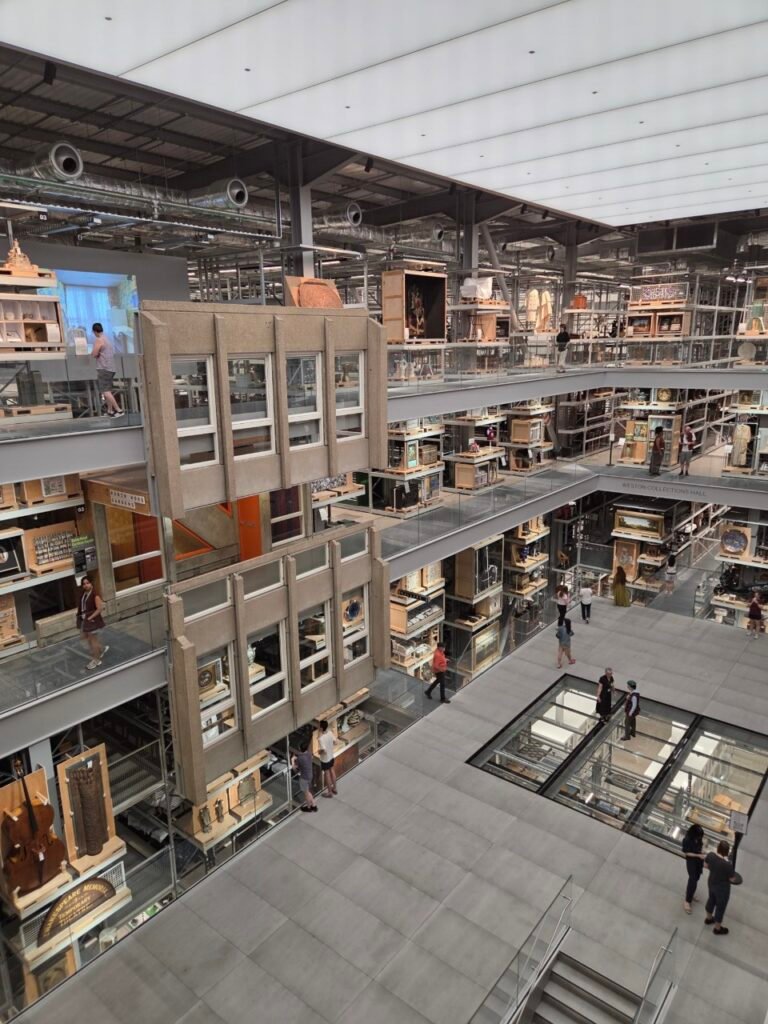
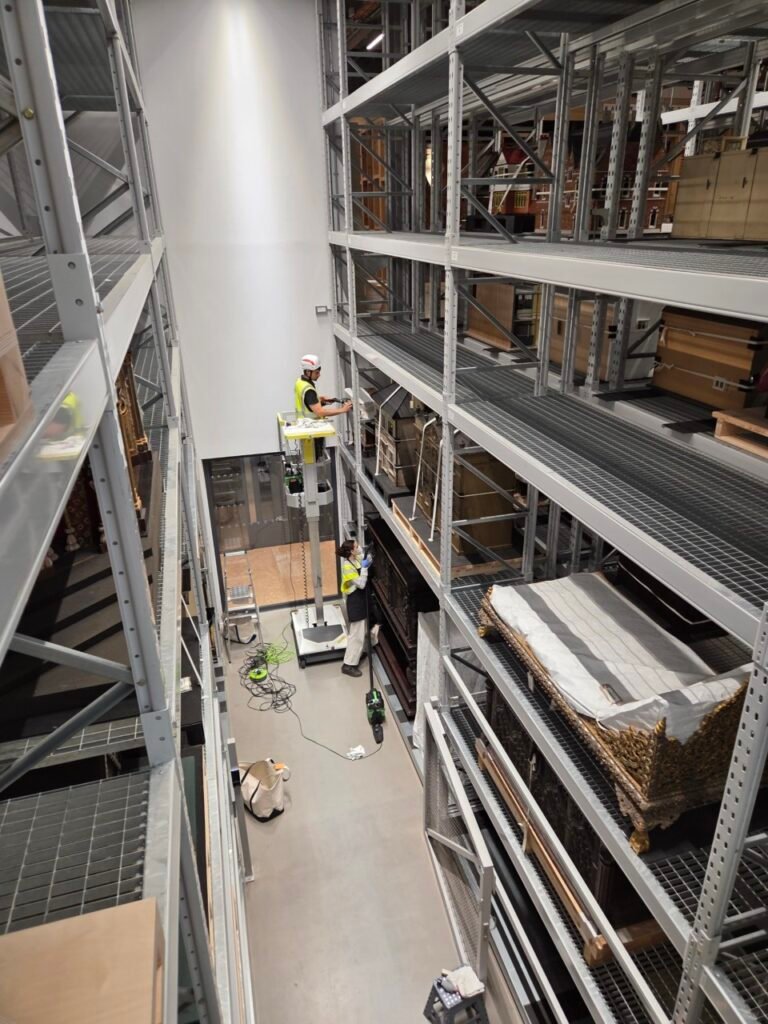
Towering shelves stretch upward for several stories, packed with furniture, sculptures, ceramics, fashion collections, stage sets, and design objects.
Walking through the space feels less like moving through a gallery and more like wandering through a giant storage facility.
In some ways, it resembles IKEA more than a museum.
Objects are not carefully arranged with polished labels and dramatic lighting. Instead, they are stored much as they would be behind the scenes. Visitors are not looking at a finished exhibition. They are looking at the machinery of the museum itself.
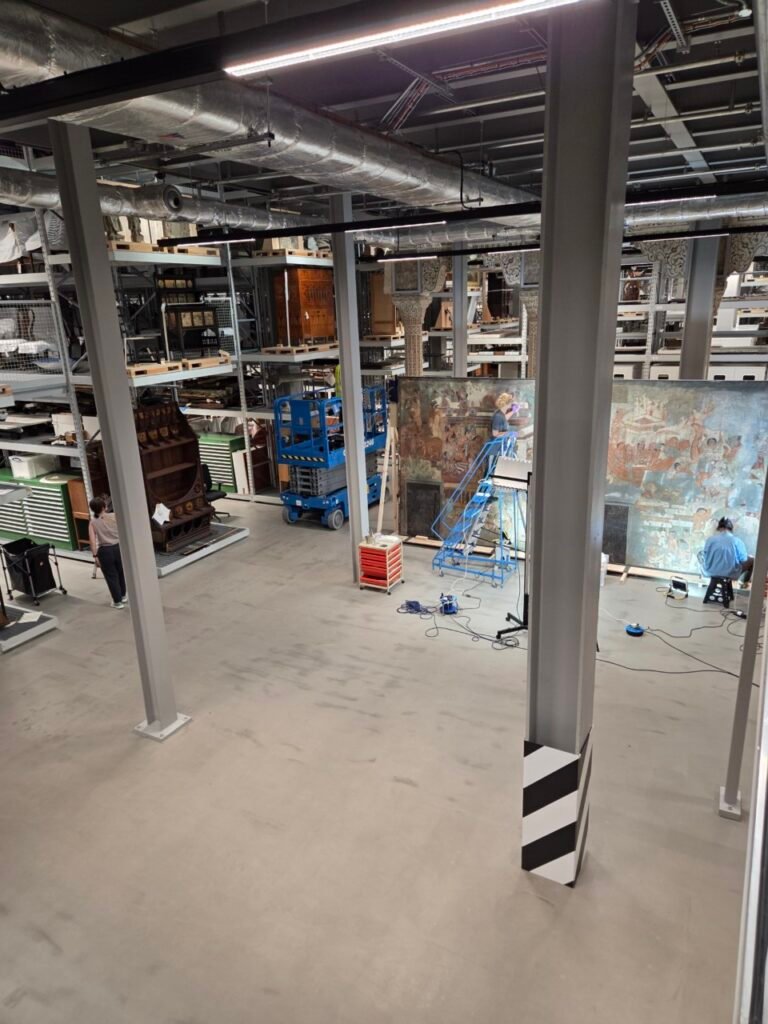
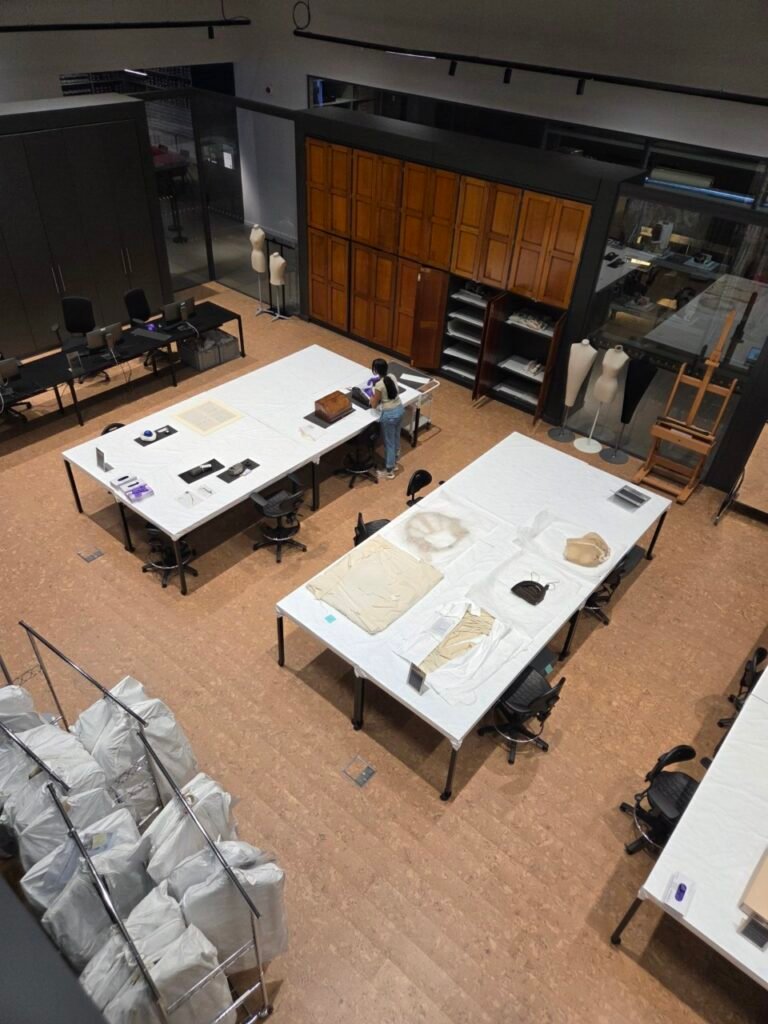
Every now and then, you also catch glimpses of staff at work.
One conservator was carefully dusting an object with a small brush. Another appeared deeply focused on restoration work.
There was something unexpectedly fascinating about watching the ordinary, meticulous labor that keeps museum collections alive.
Why the Children Loved It
What surprised me most was how much the children enjoyed it.
Rather than standing in front of a famous masterpiece, they seemed to prefer wandering between enormous shelves and asking, “What’s that?”
The experience felt less like visiting a museum and more like exploring.
There is something inherently exciting about discovering objects without being told in advance why they matter.
Every corner offered something unexpected.
The Agra Colonnade
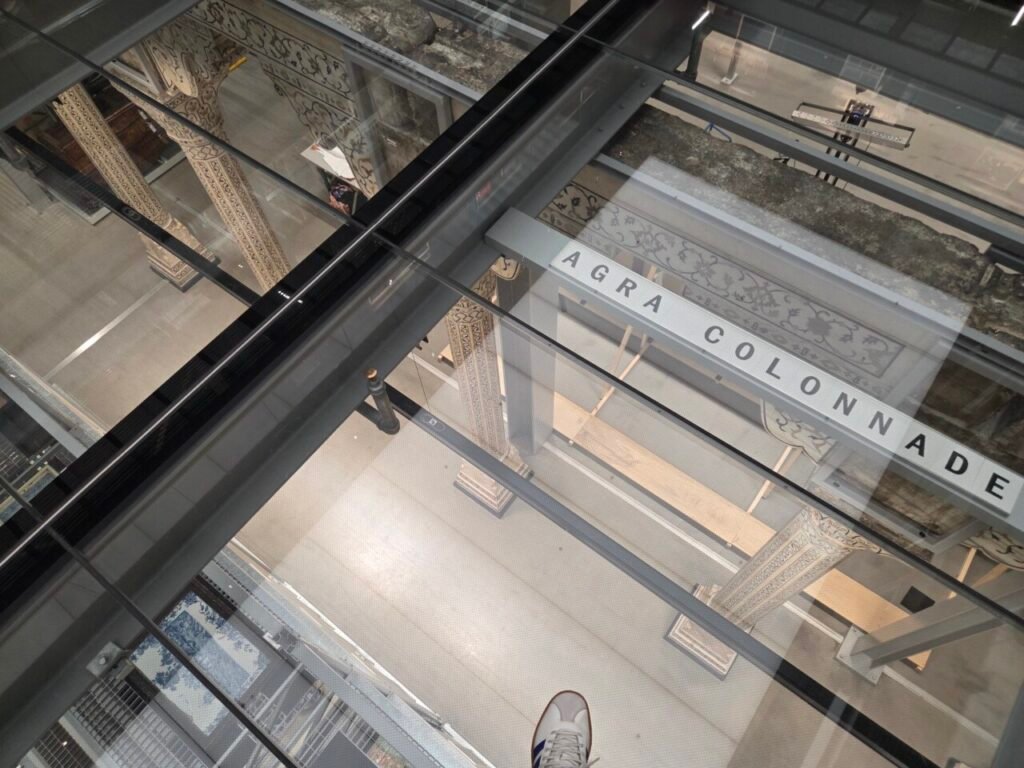
The most memorable object for me was the Agra Colonnade.
Built in seventeenth-century Mughal India, it consists of a monumental marble colonnade that is so large it would be difficult to display in a conventional gallery.
What makes it particularly memorable is the way it is displayed. The monumental marble structure stands below, while visitors view it from above through a glass floor, giving a perspective that would be almost impossible in a traditional museum gallery.
It feels almost as if part of a building has been transported intact from another century and another continent.
Seeing an object on this scale up close — and from multiple perspectives — is one of the unique pleasures of the Storehouse.
What Isn’t on Display—and Who Decides?
Most museums encourage us to focus on what is displayed.
V&A East Storehouse quietly encourages a different question:
What is not displayed?
Why are some objects selected for elegant gallery exhibitions while others remain in storage?
Who decides which stories deserve space, attention, and interpretation?
How do museums shape our understanding of history through those choices?
These questions are not presented explicitly. The building simply creates the conditions for visitors to start asking them.
That is what makes the Storehouse so interesting.
It is not really an exhibition.
It is an exploration of how museums work.
London Keeps Reinventing Itself
London has so many world-class museums that it takes quite a lot to surprise me these days.
Yet V&A East Storehouse genuinely felt new.
Many cities do an excellent job preserving the past.
Fewer cities continually find fresh ways to present it.
What impressed me most was not the collection itself, but the idea behind it: the decision to turn storage into a public experience and make the invisible visible.
That feels very London somehow.
The city never seems content simply to preserve history. It is always looking for new ways to tell it.
Practical Notes
I would happily recommend V&A East Storehouse to anyone interested in museums, design, history, or architecture.
It is also surprisingly good with children.
Instead of quietly admiring a handful of famous objects, visitors get to explore what feels like a vast treasure warehouse filled with unexpected discoveries.
The practical facilities are excellent as well. There are cafés, lockers, toilets, and plenty of space to sit and rest. During our visit it was far less crowded than many of London’s better-known museums, which made the whole experience feel relaxed and enjoyable.

We only visited the Storehouse this time, but the nearby V&A East Museum has now opened as well.
One day, on a sunny afternoon, I would like to return, walk through Olympic Park, and spend time exploring both.
One of the things I love most about London is that no matter how long you live here, it never feels finished.
There is always something else to discover.