How We Try to Raise Bilingual Children Without Losing Their Heritage Language
When people imagine raising children abroad, they usually worry about the new local language.
Will their children understand school? Make friends? Feel comfortable in a language that is not yet their own?
For many families, including mine, that language is English. For others, it may be Spanish, French, German, or something else entirely.
I worried about that too.
But after moving across countries with children and watching them settle into new schools and new languages, I realised something surprising:
the hardest part was never the new language.
It was keeping hold of the old one.
For my children, that language is Korean.
Years ago, I lived in a small Spanish-speaking country with a surprisingly large Korean community. Many families had settled there decades earlier, and one older community member told me something I still remember.
“Children here don’t forget Korean,” he said proudly.
“Second-generation Korean Americans lose it. Kids here don’t.”
At the time, I had just moved from New York and found that idea fascinating.
In America, when my children chatted with me in Korean at restaurants or hair salons, Korean adults would often react with delight.
“Wow, your child speaks Korean so well!”
The reaction itself told a story.
For many immigrant families, keeping a heritage language alive is hard.
So why did some children seem to hold onto Korean so naturally, while others slowly drifted away from it?
Not because they were naturally gifted at languages.
Not because English is somehow easier or Korean somehow harder.
The answer, I think, is much simpler:
Children tend to speak the language that is lived around them most consistently.
And for heritage languages, much of that work happens at home.
If parents continue using the family language in ordinary, everyday life, children are far more likely to hold onto it.
Children speak the language that continues to feel alive around them.
And for most children growing up abroad, English arrives naturally.
School. Friends. Playgrounds. Clubs. Screens.
At some point, they begin using words you have never taught them. They start correcting your pronunciation of local slang. Their accent becomes effortless.
In Britain, English feels as natural to my children as breathing.
Korean does not.
Korean disappears quietly if nobody protects it.
I have lived in seven countries and moved internationally with my children roughly every three years. Along the way, I have watched many children become fluent in new languages with astonishing speed — and drift away from their heritage language just as quickly.
Some children who spoke Korean confidently in early primary school lost much of it within a couple of years after moving abroad.
Every family has different circumstances, and I do not believe in judging parents. Raising bilingual children is hard enough already.
But for me, helping my children keep Korean matters deeply.
Not because I expect perfect grammar.
Not because I want them to sound like children growing up in Seoul.
But because language is connection.
Connection to grandparents. Family jokes. Childhood memories. Stories. Identity.
So while we are very much a work in progress, there are a few simple rules we try to follow at home.
1. Korean at home — always
This is our biggest rule.
Outside, my children naturally live in English. That is inevitable.
At home, we try to create a space where Korean still feels normal.
Sometimes English slips in, especially after a long school day. When that happens, I gently redirect them.
“Tell me in Korean.”
Not perfectly. Not always patiently.
But consistently.
Because children need immersion in a heritage language just as much as they need exposure to the dominant one.
2. Reading every day
Speaking and listening come relatively naturally when parents consistently speak the family language at home.
Reading and writing are much harder.
That part takes effort.
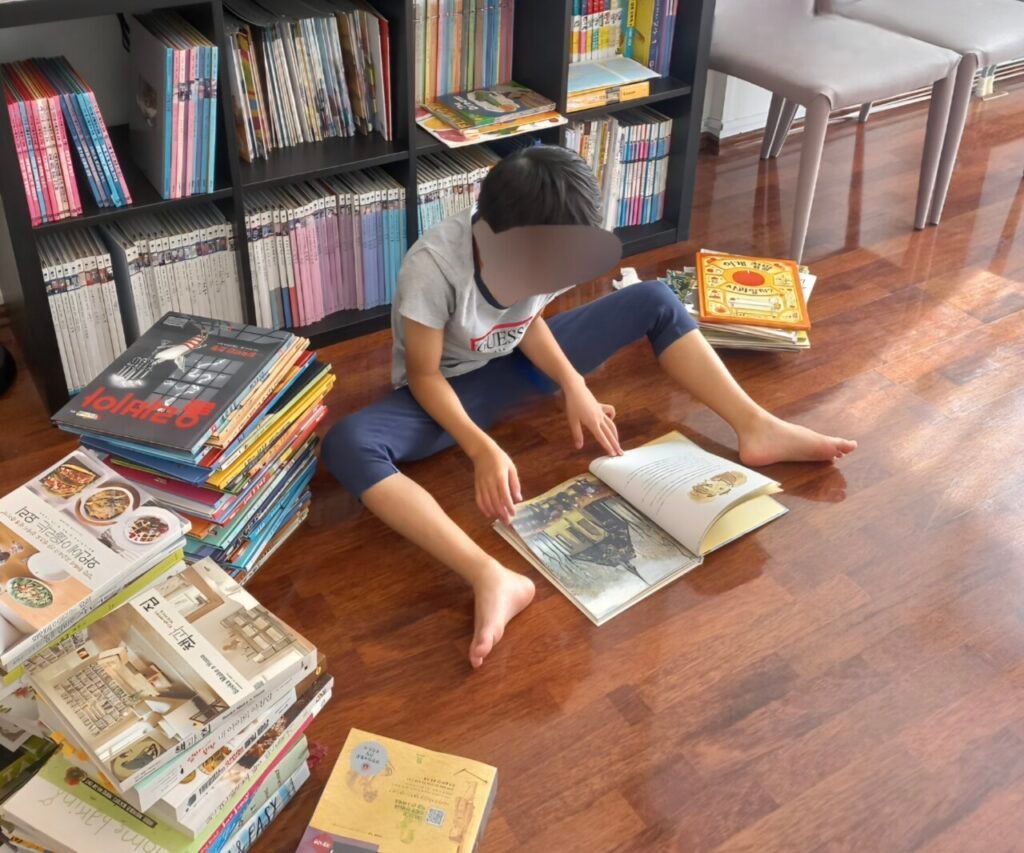
We try to read Korean books every day, even if only for thirty minutes.
My older child now reads independently, but my younger one still reads with me.
And honestly, it is tempting to stop reading aloud once children technically can read.
But especially for bilingual children educated entirely in English, reading together builds vocabulary, comprehension, and confidence in Korean in ways independent reading often does not.
Eventually something changes.
One day, a child quietly picks up a Korean book on their own.
And that feels like a small miracle.
3. Finding Korean content they genuinely enjoy
This matters more than parents sometimes admit.
Children stay with what feels fun.
For my children, Korean comic books and YouTube videos became part of everyday life.
The humour, slang, cultural references, silly jokes — all of it quietly strengthened not only language but cultural familiarity too.
When children enjoy content in the language, half the battle is already won.
4. Community matters
Weekend Korean schools, playgroups, community events — anything helps.
Children need to see that Korean is not just something spoken with Mum.
They need friendships, shared jokes, celebrations, and moments that make the language feel socially alive.
5. Keeping Korea emotionally real
We are fortunate to visit Korea twice a year, usually during the Christmas and summer holidays, though I know many families do not have that option.
Still, whenever possible, regular visits to a family’s home country can matter deeply. Time with grandparents, family routines, familiar food, inside jokes, shared memories — these small things quietly strengthen both language and belonging.
Language grows stronger when attached to love, relationships, and lived experience.
Eventually, Korean stops feeling like homework.
It becomes part of who they are.
A mother tongue and a dominant language are not always the same thing.
My children may eventually study, work, and live mostly in English. English may become their strongest language.
That is okay.
I am not trying to stop that.
I simply want Korean to remain open to them.
Because keeping a heritage language is not just about preserving words.
It is about keeping another way of seeing the world.
And perhaps that is one of the greatest gifts immigrant parents can give their children.